
The call came at 10:42 p.m., according to Ross Kellen’s father’s watch, which meant it was actually 10:39.
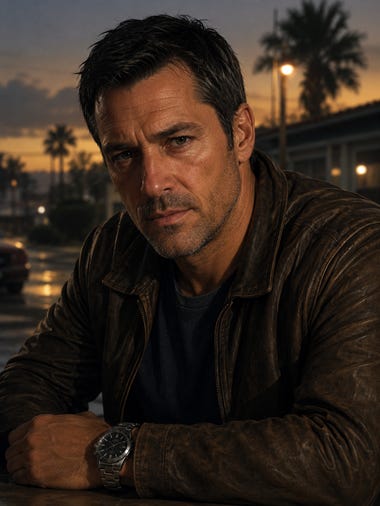
The old stainless-steel Seiko had been running three minutes fast for twenty-one years. A jeweler once offered to fix it while Ross waited, but Ross had walked out with the watch still wrong. His father, a county deputy with a bad back and a hard stare, had worn that same watch through twenty-seven years of domestics, robberies, bar fights, and one fatal stop on County Road 581.
“A man late to trouble,” his father used to say, tapping the crystal, “is no good to anybody.”
So Ross let the watch run fast.
These days, he checked it too often. At red lights. Outside courtroom doors. In the parking lot of the family exchange center. Anyplace where being three minutes early still somehow felt too late.
He was sitting at his kitchen table when the phone rang, a custody petition spread in front of him like a murder scene. His brown leather jacket hung over the chair beside him, scarred at one sleeve from a broken beer bottle and soft from years of Florida sweat and bad weather. In the inside pocket were two small hair ties, one purple, one yellow, left behind by his daughters during his last weekend with them.
Emma wore purple. Ellie wore yellow.
That was not the only way he could tell his identical twins apart. He knew them by footsteps, by breathing, by how Emma entered a room like she owned it and Ellie paused first, measuring the air. But the hair ties were proof. Small things mattered when lawyers were trying to reduce fatherhood to visitation blocks.
The phone rang again.
Ross glanced at the number. He did not recognize it, which meant he answered. Detectives answer strange numbers, even when they are off duty, even when they are tired, even when they know better.
“Ross?”
The voice was familiar, but not enough to be safe.
“Yeah.”
“It’s Niki.”
He leaned back and closed his eyes.
There were three people he did not want to talk to that night. His ex-wife, Rose. Her father, Blake Varnum. And the woman he had taken to dinner two nights earlier, slept beside for six hours, then quietly decided never to call again because she had laughed too easily and looked him in the eyes when she spoke.
“Niki,” he said.
“Bad time?”
He looked down at the custody petition.
Unstable temperament.
Questionable judgment.
Excessive work hours.
Exposure of minor children to dangerous elements through law enforcement employment.
“Not great.”
“I won’t keep you,” she said. “I just... I guess I wanted to explain something. About the other night. I know I probably came off like a disaster.”
Ross said nothing.
“That guy I mentioned,” she continued. “Eddie. He didn’t just leave. He cleaned me out. Savings, credit cards, everything. I don’t usually tell people that, especially not on a first date, but after we-”
“Niki,” Ross cut in, sharper than he meant to. “What exactly are you looking for here?”
The line went quiet.
He heard himself breathing. He heard the refrigerator hum. He heard, too late, the cruelty in his own voice.
“What?” she said.
“I’m asking what this is. A confession? A warning? A late-night therapy session?”
“Wow.”
He rubbed his eyes. “I didn’t mean it like that.”
“You absolutely meant it like that.”
“Niki--”
“Why are you getting testy? I was just telling you a little about me.”
“I’m not getting testy.”
“You answered like I was a warrant.”
“Why should I care? We had one date. Things went south. Besides, who are you to call and unload your stuff on me?”
Silence moved across the line.
Then she said, “You’re right. I’m just some first date you dragged home for a quick hump. I’m sorry I called. I’m sorry I bothered you with my stuff. If you want to hang up, this would be the time.”
Ross looked down again at the petition.
The accusations had been typed in clean legal sentences, the kind that gave cruelty a necktie. Rose had not written them. Ross knew that. Rose was many things--spoiled, frightened, bitter, dependent on her father’s money-but she did not wound with precision.
That was Blake.
Blake Varnum owned three marinas, two concrete companies, a private security firm, and enough local politicians to make elections feel ceremonial. Nothing stuck to him. Charges dissolved. Witnesses forgot. Accountants moved to Belize. Men who owed Blake money paid him back or disappeared in the fog between Tampa and Hernando County.
Now Blake wanted Emma and Ellie.
Not because he loved them more than Ross did.
Blake did not love.
Blake acquired.
“Look,” Ross said into the phone, “right now I’m no good to anybody. If you get off at this stop, you’ll be better for it.”
“Maybe,” Niki said. “But I thought you were handsome, interesting, and a good listener. That restaurant must have set you back a couple hundred dollars. I would have been happy with a hamburger.”
“It’s not your stuff,” he said. “It’s mine, okay?”
“Okay.”
“You’re beautiful. You must know that. And a guy you loved ripped you off and left you broke. I’m sorry that happened. But I’m tired of love. It’s chaotic. It’s vengeful. It hires lawyers and tells judges you’re dangerous because you carry a badge.”
Another silence. Softer this time.
“You have kids,” Niki said.
“Two girls. Identical twins.”
“How old?”
“Eight.”
“Names?”
“Emma and Ellie.”
“I’m guessing you can tell them apart.”
“In the dark. From the sound of one footstep.”
“That’s not nothing, Ross.”
He looked toward the refrigerator, where a drawing was held by a magnet shaped like a dolphin. Two stick girls stood under a bright orange sun beside a stick man with a square badge. Over the drawing, Emma had written: Daddy finds bad guys.
“I’m not in love with the guy who stole from me,” Niki said. “That’s over.”
“I didn’t say you were.”
“You kind of did.”
“Then I’m sorry.”
“All I’m saying is that you seem like a good person,” he said. “Me, not so much. Not right now. But I am sorry I snapped at you. And I’ll always remember that night.”
“So I don’t understand,” she said. “This is it? I shared something intimate at the wrong moment, and now I’m dismissed?”
“Niki--”
“I’m not convinced this is my stop. Are you?”
Ross pressed his fingers into the bridge of his nose. He heard her breathing. He heard the refrigerator hum. He heard, somewhere in his own chest, the old tired machinery of retreat.
“No,” he said.
“No what?”
“No, I’m not convinced.”
“Good.”
“I have to pick up my dog at my sister’s house. You interested? She lives near your place. I could pick you up.”
“You have a dog?”
“Shep.”
“What kind?”
“A two-year-old overgrown German shepherd.”
“Shep the shepherd. How original.”
“Yeah, I get that a lot.”
“He friendly?”
“He’s fixed and has all his shots.”
“That’s okay. I’m sure he won’t bite. It’s you I worry about.”
“Yeah,” Ross said. “I had that coming.”
“Call me when you’re close.”
“Deal.”
“Ross?”
“Yeah?”
“Forgiven.”
He smiled despite himself.
“But your alter ego is kind of shitty.”
“That’s what I keep telling him.”
After she hung up, Ross stayed at the table a moment longer. Then he folded the custody petition and placed it in the folder beside a photograph of his daughters. In the picture, Emma had ketchup on her cheek and Ellie was missing one front tooth. They were holding Shep between them like a captured wolf.
Ross stood, slipped into the old leather jacket, and felt the hair ties in the inside pocket brush his knuckles.
He told himself he was just picking up a dog.
But even then, before the night opened its mouth, he knew that was not true.
His sister Caroline lived fifteen minutes away in a little block house with hurricane shutters, ceramic angels in the flower bed, and no patience for Ross’s self-pity.
When he pulled into her driveway, Shep was already at the front window, hammering the glass with his tail.
Caroline opened the door before Ross knocked.
“You look terrible,” she said.
“Nice to see you too.”
“Rose’s lawyer?”
“Blake’s lawyer wearing Rose’s name.”
Caroline stepped aside. Shep launched himself at Ross and nearly knocked him into a lamp.
“Hey, buddy,” Ross said, burying one hand in the dog’s thick fur. “You behave?”
“He ate one of my potholders.”
“So, yes.”
Caroline crossed her arms. “You going home?”
“Not exactly.”
Her eyebrows lifted. “Oh?”
“I’m picking up someone.”
“A woman someone?”
“Don’t start.”
“I’m not starting. I’m observing. There’s a difference.”
Ross clipped Shep’s leash to his collar.
Caroline looked him over. “Same jacket.”
“It’s cold.”
“It’s seventy-four degrees.”
“It might get cold.”
“You wear that jacket when you’re scared.”
Ross stopped at the door.
Caroline softened. “Daddy wore that watch when he was scared too.”
Ross looked down at the Seiko.
“He never admitted being scared.”
“Neither do you. It runs in the family.”
She touched his arm before he could leave. The teasing slipped from her face. “Ross, Blake had a man parked across the street today.”
He went still. “Here?”
“Black Tahoe. Tinted windows. I walked out to get the mail, and he drove off.”
“You sure?”
“I was married to a state trooper for twelve years. I know when a car is parked and when a car is watching.”
Ross looked toward the dark street. His grip tightened on the leash.
“Did the girls see?”
“No. They were inside making slime in my kitchen.”
“You should have called me.”
“And you would have done what? Arrested a Tahoe?”
He did not answer.
Caroline lowered her voice. “Blake is not playing family court. He’s playing ownership.”
“I know.”
“Then stop acting like you can fight him alone.”
Shep whined, eager to go.
“I’m not alone,” Ross said.
Caroline looked at him sadly. “Not yet, maybe.”
Niki lived in a second-floor apartment over a closed travel agency in a strip plaza that had seen better decades. Her porch light was out. Ross noticed that first. Then the stairwell. Then the rear alley. Then the dented blue hatchback with a missing hubcap and a bumper sticker that said MY DOG IS MY THERAPIST.
Niki came down the stairs carrying a small white Shih Tzu under one arm.
She wore jeans, sandals, and a faded green blouse. Her hair was tied up messily, and she had a little red notebook tucked under her arm. A cheap silver ring circled her right thumb. She twisted it once when she saw him, then stopped herself.
The little dog barked once at Shep, then reconsidered.
“This is Moxie,” Niki said. “She thinks she’s a wolf.”
Shep sat down immediately, as if accepting the chain of command.
“Moxie,” Ross said. “That’s a better name than Shep.”
“Almost every name is.”
They stood under the bad porch light, awkward now that neither had a phone line to hide behind.
“Thank you for coming,” she said.
“I was already out.”
“No, you weren’t.”
He looked at the dark travel agency window. “Your porch light out long?”
“Three days.”
“Landlord know?”
“Landlord knows nothing unless money is stapled to it.”
Ross nodded. He could feel himself cataloging the place automatically.
Niki noticed.
“Do you ever stop detecting?”
“No.”
“That must be exhausting.”
“It is.”
They walked the dogs around the cracked edge of the strip plaza. Traffic hissed on the highway. A neon beer sign blinked in the window of a bar two doors down. Shep kept himself between Niki and the shadows without being told.
Niki watched the dog, then Ross.
“You two are alike.”
“Shep and me?”
“Big, suspicious, badly named.”
“I didn’t name myself.”
“Your parents did fine. Ross sounds like a man who owns one jacket and apologizes badly.”
“That’s oddly specific.”
“I’m observant too.”
Niki twisted the thumb ring again. Ross nodded toward it.
“Nervous habit?”
“Ownership habit.”
“What does that mean?”
“It means I bought this after Eddie emptied my account. Twelve dollars and ninety-nine cents. First thing I paid for with money he hadn’t touched.” She looked down at the ring. “It’s ugly, but it’s mine.”
“It’s not ugly.”
“You’re a terrible liar.”
“I’m an excellent liar. I just don’t waste my powers on jewelry.”
She laughed, and the sound surprised him by getting through.
“What’s the notebook?” he asked.
“My financial recovery plan.”
“That sounds official.”
“It is. Every dollar I owe is in here. Every payment. Every humiliating interest charge. Eddie took my savings, not my math.”
Ross glanced at the notebook with new respect.
“You said the guy ripped you off,” he said.
“Smooth transition.”
“Sorry.”
“No, it’s fine. His name was Eddie Vale. He was charming in the way a fire is charming when you’re freezing. He convinced me to help him start a mobile detailing business. My savings. A small loan. A credit card I’m still paying. Then one day, he was gone.”
“How much?”
“Twenty-three thousand if you count interest and stupidity.”
“Stupidity doesn’t count.”
“It should.”
“What did he do before detailing?”
She looked at him. “This is you caring?”
“This is me listening badly.”
“He worked books for different people. Restaurants. Small construction companies. Marinas. Cash businesses.”
Ross stopped walking.
Niki took another step, then turned. “What?”
“Which marinas?”
“I don’t know. He never said names.”
“Did he ever mention Blake Varnum?”
Her face changed. Not much. Enough.
“Niki.”
She hugged Moxie closer. “He said the name once. On the phone. He thought I was asleep. He said, ‘Tell Varnum he’ll get his money when I’m sure I won’t be the only one going down.’”
Ross felt the night narrow around them.
“When was that?”
“Two weeks before he disappeared.”
“Did you tell anyone?”
“Who was I supposed to tell? The police? I had no proof of anything except being a fool.”
“You’re not a fool.”
“You don’t know me well enough to say that.”
“I know fools. It’s part of my job.”
Moxie growled softly at the alley behind the plaza.
Ross turned.
A man stood near the Dumpster, half in shadow, half in yellow security light. Big shoulders. Baseball cap. Hands loose at his sides. He was not smoking, not using a phone, not taking trash out.
He was just there.
Ross moved one hand near his jacket, making room for the pistol on his hip.
The man stepped backward into the dark alley and vanished.
Shep did not bark. That worried Ross more than if he had.
Niki looked at Ross. “That wasn’t a neighbor.”
“No.”
“And you’re about to say something calm that is actually terrifying.”
“You should pack a bag.”
“Yep, that qualifies.”
He drove Niki to Caroline’s house without asking. She did not argue. By midnight, Niki was drinking coffee at Caroline’s kitchen table while the dogs slept under the chairs and Ross stood in the living room calling in favors.
At 12:31 a.m., dispatch confirmed a body had been found in a burned-out storage unit near Varnum Harbor Marina.
At 1:07 a.m., the body was identified by dental records.
Edward Vale.
Niki sat very still when Ross told her. For a moment he thought she might cry, but she did not. She touched the silver thumb ring, turned it once, then opened the red notebook and stared at a page of numbers as if math could keep the room from spinning.
“They’ll think I did something,” she said.
“No.”
“You don’t know that.”
“I do.”
“How?”
“Because whoever killed Eddie didn’t kill him over twenty-three thousand dollars. They killed him because he had something worth more.”
She looked up. “Something about Blake.”
Ross did not answer.
By morning, Ross was officially removed from the Vale homicide because of a personal connection to a witness. That was procedure. He signed the acknowledgment, handed the file to Detective Monroe, and then spent the next ten hours being very careful not to investigate a case everyone knew he was investigating.
At noon, Blake Varnum’s attorney filed an emergency motion claiming Ross had exposed Emma and Ellie to criminal retaliation by associating with a “financially unstable woman connected to a homicide investigation.”
At 12:17 p.m., Ross got the scanned copy in his email.
At 12:18 p.m., Rose called.
He answered in the parking lot behind headquarters.
“You need to stop,” Rose said.
“Hello to you too.”
“Daddy says this is getting dangerous.”
“Daddy had a man watching Caroline’s house.”
“That’s not true.”
“It is.”
“You always do this. You make everything sound like a case.”
“Rose, are the girls okay?”
A pause.
“They’re fine.”
“I want to talk to them.”
“They’re at school.”
“I’ll call tonight.”
“Daddy says maybe that’s not a good idea until court.”
“Daddy doesn’t get to say.”
Her voice broke then, just slightly. “You don’t know what he’s like when he’s angry.”
Ross leaned against his truck and looked at his father’s watch.
“I know exactly what he’s like.”
“No. You don’t. You can arrest people and walk away. I had to grow up in his house.”
There it was--the Rose he had once loved, before money and fear and pills and custody orders had hollowed out everything soft between them.
“Then help me,” he said.
“I can’t.”
“You can.”
“No, Ross. You can stand up to him because you still believe rules matter. I know better.”
The call ended.
That evening, Ross picked up Emma and Ellie for his court-ordered dinner visit at a neutral exchange center with bright walls and dead-eyed security cameras.
The girls ran to him in matching purple backpacks.
“Daddy!”
He crouched and caught both of them at once, inhaling shampoo, crayons, and the particular sweetness of children who still believed a father’s arms could fix the world.
Emma pulled back first. “Grandpa said you’re mad.”
“Grandpa says a lot of things.”
Ellie touched his cheek. “Are you?”
“Sometimes.”
“At us?”
“Never.”
They ate pancakes for dinner because that was one of the few laws Ross still respected. At the diner, Emma drowned hers in syrup while Ellie cut hers into perfect squares.
“Where’s the sacrifice pancake?” Emma asked.
“At home.”
“You always burn the first one.”
“That’s why it’s a sacrifice.”
Ellie nodded seriously. “For the pancake gods.”
Ross smiled, and for a few minutes he was not a detective, not a defendant in family court, not a man with Blake Varnum’s shadow over his roof. He was only Dad, pouring too much syrup and pretending not to notice.
Then Ellie looked toward the window.
“Grandpa’s car is outside.”
Ross did not turn quickly. He kept his face easy, lifted his coffee, and glanced at the reflection in the glass.
A black Tahoe sat across the street.
Something cold and clean passed through him.
He paid the check, walked the girls to his truck, buckled them in, and drove--not to the exchange center, not to his house, but to the sheriff’s substation two miles away.
The Tahoe followed for six blocks, then vanished.
Inside the substation, Ross called his lieutenant. Then he called Monroe. Then he called the one person he had not wanted to drag deeper.
Niki answered on the first ring.
“I found something,” she said.
“You found what?”
“Eddie mailed me a package. It came today. No return address, but it’s his handwriting.”
Ross closed his eyes. “Where are you?”
“Caroline’s.”
“Good. Don’t open it.”
“Too late.”
“Niki.”
“There’s a flash drive, a key, and a note.”
“What note?”
Her voice trembled as she read.
“’Nik, I was going to come clean. I swear. I got greedy and scared. Varnum owns judges, cops, everybody. If I vanish, this is why. Don’t trust men with clean shoes.’”
Ross looked down the hall where Emma and Ellie were sitting in plastic chairs, sharing a vending machine honey bun.
“What’s on the drive?”
“I don’t know. I was afraid to plug it in.”
“Good. Don’t.”
“There’s also a key. Bank maybe. Number stamped on it.”
“Listen to me. Put everything back in the package. Give it to Caroline. Lock the door. I’m sending a deputy.”
“I’m scared, Ross.”
“I know.”
“No. I mean I’m scared, and I still wish you were here. That’s inconvenient.”
Despite everything, he almost laughed.
“I’ll get there.”
“Ross?”
“Yeah?”
“Don’t be heroic. I’m starting to like you, and I have terrible timing.”
“You and me both.”
The deputy arrived at Caroline’s in eight minutes. Ross arrived in sixteen with his daughters asleep in the back seat.
By then, Niki had made more coffee, Caroline had produced a baseball bat from somewhere, and Shep had positioned himself in front of the hallway like a soldier.
The flash drive went into an evidence bag. The key went into another. The note went into a third.
Ross did not touch any of it.
Monroe came personally. He was a broad, tired man with silver hair and a tie that always looked like it had been put on during a foot chase.
“You understand,” Monroe said quietly, “if this is real, it’s not your case anymore in any universe.”
“I understand.”
“You don’t, but say it again anyway.”
“It’s not my case.”
Monroe looked at Niki. “You willing to make a statement?”
Niki twisted the silver thumb ring until Ross thought she might bend it.
Then she looked at Emma and Ellie asleep on Caroline’s couch, one under a purple blanket, one under yellow.
“Yes,” she said.
The key belonged to a private box at Suncoast Federal. Inside the box were three ledgers, two burner phones, and a thumb drive containing recordings Eddie Vale had made during the last month of his life.
Not all of it was admissible. Some of it was rumor, some was paranoia, and some was Eddie trying to make himself sound less guilty than he was.
But one recording mattered.
Blake Varnum’s voice was unmistakable.
“You keep the books clean, Eddie. You keep the judge comfortable, you keep Rose quiet, and you keep that detective chasing parking tickets. I want my granddaughters in my house before Kellen figures out why.”
Another voice asked, “And if he does?”
Blake laughed.
“Then he loses his badge, his girls, or his breathing. I’m flexible.”
The judge recused himself that afternoon.
Blake’s attorney withdrew the emergency motion two hours later.
By sunset, two state investigators and one federal agent had joined the case, which meant everyone suddenly used words like alleged and ongoing and declined to comment.
Ross went home at midnight to find Niki sitting on his porch with Moxie in her lap and Shep at her feet.
“You shouldn’t be here,” he said.
“Probably not.”
“It’s not safe.”
“I know.”
“Then why?”
She looked past him into the house, where the girls had left two pairs of sneakers beside the door and a pink hairbrush on the coffee table.
“Because after Eddie, I promised myself I’d run at the first sign of danger. It sounded smart at the time.”
“It is smart.”
“No. It’s safe. Not the same thing.”
He sat beside her.
For a while, they said nothing. Crickets worked in the dark. Somewhere down the street, a dog barked twice and gave up.
“You loved Rose?” Niki asked.
“Yes.”
“Still?”
“No. But I remember the version of me who did.”
“That’s honest.”
“It’s inconvenient.”
She smiled faintly. “You use that word when you’re scared.”
“What word?”
“Inconvenient.”
He looked at her and felt something in him step back from the ledge.
“I don’t have much to offer right now,” he said.
“You have pancakes for dinner, a badly named dog, and two little girls who know you can tell them apart in the dark.”
“That’s not a dating profile.”
“It’s better than most.”
He almost reached for her hand, then stopped.
She noticed but did not punish him for it.
The arrest came three days later, but not Blake’s. Men like Blake rarely went first. They stood behind tinted glass and let smaller men bleed.
The first arrest was Sal Borrelli, Blake’s marina manager, who had made the mistake of keeping the gun that killed Eddie Vale. The second was a Varnum security guard named Jensen, the man from the alley behind Niki’s apartment. The third was Rose’s private driver, who confessed to planting a bag of pills in Ross’s truck that had not yet been “discovered” before the investigation rolled over him.
Blake held out until the fourth arrest.
That was his lawyer.
After that, rich men began remembering appointments overseas.
But Blake was stopped at Tampa International with seventy thousand dollars in cash, two passports, and a face full of disbelief that the world had developed consequences.
The custody hearing took place six days later in a different courtroom, before a different judge, with two deputies standing along the back wall.
Ross wore his only good suit and his father’s watch. He had left the leather jacket at home, but he had moved the purple and yellow hair ties into his suit pocket. He touched them once before the judge entered, not for luck, exactly, but for memory.
Caroline sat behind him. Niki sat beside Caroline, hands folded tightly in her lap. She had offered not to come, but Ross had asked her to.
Rose arrived with no Blake, no entourage, no polished attorney whispering in her ear. She looked smaller than Ross remembered. Not weak. Just human.
When she took the stand, she did not look at Ross at first.
The judge asked her if she wished to proceed with her petition for primary custody.
Rose closed her eyes.
“No, Your Honor.”
Ross felt Caroline grip his shoulder from behind.
Rose swallowed. “I love my daughters. I want time with them. But I have not been well. My father pushed this because he wanted control of them and control of Ross. I let him because I was afraid and because it was easier to blame Ross than admit what my family is.”
Her eyes finally found his.
“He is a good father,” she said. “He always was.”
Ross looked down.
The judge granted Ross primary residential custody that afternoon. Rose received supervised visitation pending psychological treatment and review. It was not a victory in the way people imagined victories. No music swelled. No wound closed. Rose cried in the hallway with her hand over her mouth, and Ross felt no joy in it.
He walked over to her while everyone pretended not to watch.
“You can still be their mother,” he said.
She wiped her face. “Do you hate me?”
“I tried. It was too much work.”
That broke her. She laughed once through tears, then leaned against the wall.
“Tell them I’m sorry.”
“Tell them yourself when you’re ready.”
She nodded.
As Ross turned to leave, Rose said, “Who is she?”
He looked toward Niki, who stood near the elevators with Caroline and the girls. Emma and Ellie were circling Moxie like she was visiting royalty. Niki crouched and let Ellie place a yellow sticker on Moxie’s collar.
“Her name is Niki.”
“Is she good?”
Ross watched Niki hold out one hand to Emma, solemnly accepting a purple sticker for her thumb ring.
“She’s inconvenient,” he said.
Rose smiled sadly. “That sounds like your type.”
That evening, Ross took the girls, Niki, Caroline, two dogs, and three pizzas to his house.
Emma and Ellie gave Niki a tour as if she were buying the place. They showed her their room, their secret drawer, the loose tile in the bathroom, the place in the backyard where Shep had buried a television remote.
Ross stood in the kitchen listening.
For the first time in months, the house sounded like a house instead of evidence.
Later, after Caroline took the girls for ice cream and the dogs collapsed in the living room, Ross and Niki stood at the sink washing plates.
“You survived,” she said.
“For now.”
“No. Don’t do that.”
“Do what?”
“Act like happiness is a suspect you haven’t cleared yet.”
He handed her a wet plate. “Occupational hazard.”
She dried it slowly.
“I’m not asking you for promises,” she said. “I’m not asking to move in, raise your children, love your dog, or fix whatever Rose broke.”
“Shep is lovable, and big. Okay, sometimes he knocks people down.”
“I’m serious.”
“I know.”
“I just need to know whether I’m still on the bus.”
Ross looked at her. There was no glamour in the moment. No restaurant, no wine, no first-date shine. Just pizza grease, sink water, two tired people, and the wreckage behind them.
He thought of the night she called. The way he had tried to push her off at the first stop because fear often disguised itself as mercy.
He thought of Emma and Ellie asleep under his roof.
He thought of Rose telling the truth.
He thought of Eddie Vale, greedy and scared, still managing one decent act before the dark took him.
He looked down at his father’s watch.
Three minutes fast.
Still wrong.
Still useful.
“I don’t know where the bus is going,” Ross said.
Niki nodded, bracing.
“But no,” he said. “This isn’t your stop.”
She let out a breath that might have been a laugh and might have been something closer to crying.
Then she stepped forward and kissed him.
It was not the kind of kiss people write songs about. It was too careful for that. Too aware of bruises. But it stayed. It asked permission. It gave it.
From the living room, Shep lifted his head and barked once.
Moxie answered with a tiny growl.
Niki leaned her forehead against Ross’s chest.
“Your dog is judging us,” she said.
“He judges everybody.”
“And your alter ego?”
Ross wrapped his arms around her carefully, as if learning the shape of something fragile and living.
“He’s still kind of shitty,” he said. “But we’re working on him.”
Outside, a car passed slowly, then kept going.
Inside, the house held.
For one night, that was enough.
Another homer, Larry!