
by Larry D. Clifton
The morning sun pressed hard against the riverbank, already nudging the temperature past eighty. A steady breeze moved through the tall trees, casting wavering ghost-shadows across the dirt and over the rows of tents and makeshift shelters scattered along the water’s edge.
From a distance, the place might have looked peaceful. Almost pretty. A careless person driving over the bridge might have seen the river shining through the trees and thought of fishing lines, folding chairs, and children skipping stones.
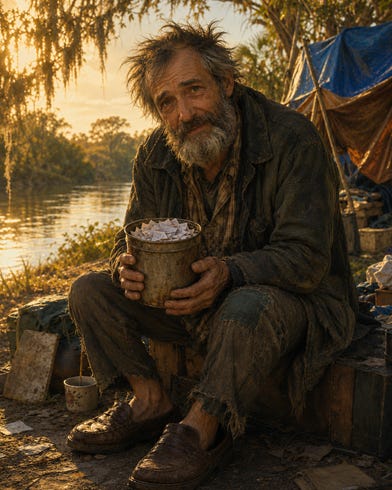
But down by the bank, where the people lived, beauty was something you had to look around to find.
Canvas patched with duct tape. Tarps weighted down with cinder blocks. Plastic grocery bags tied to branches. The sour smell of bodies that had gone too long without soap. The low murmur of coughing, muttering, and the scrape of cheap lighters coaxing damp cigarettes to life.
People stirred from their nylon cocoons, rubbing sleep from their eyes and stretching limbs made stiff by another night on the ground. The day’s hunt—for food, for shade, for cigarettes, for luck, for anything—had already begun.
Angie Ogden had pitched her newest tent close to the river the previous evening. Close enough to guard it. Close enough to slip into the water before the encampment fully awakened.
Bathing wasn’t luxury.
It was rebellion.
Every time Angie dunked her head beneath the muddy river, every time she scrubbed her arms with the last sliver of soap and twisted water from her hair, she felt she was saying something to the world.
You won’t take this from me.
She hung her rinsed clothes on a low oak limb and squeezed the last drops from a faded blouse. Her jaw still ached from sleeping on hard ground, but nothing compared to what was coming. Morning always had teeth. It never arrived alone. It brought hunger, heat, memory, and the shame of being seen in daylight.
Footsteps approached behind her—heavy, careless. The kind only someone new to hunger makes.
Angie turned.
A man in his early thirties moved toward her tent like he had a deed to it. His belly pressed against a stained gray shirt. His face had that dangerous softness of a man who had lost things recently and blamed strangers for it. His shoes were scuffed, but still held the ghost of polish.
New to the streets.
Dangerous for that reason alone.
He circled her tent, running grimy fingers along the seams. Then he yanked the flap open and leaned inside as if inspecting something he had paid for.
Angie stepped forward, fists clenched.
“Hey! I got friends here. You touch my stuff, I’ll scream this whole camp awake.”
The man laughed. A sharp, humorless bark.
“You’re lying, old woman. You just set up yesterday. I been eyeballing this tent. It’s mine.”
“Find your own,” she snapped. “I’m not afraid to scream.”
His fist struck before she registered the movement.
Her jaw buckled.
The dirt rushed up to meet her.
By the time her vision cleared, he was already dragging the tent toward the trees, one aluminum pole scraping behind him like a broken bone.
Angie spit blood and wiped her mouth with the back of her hand. The tent was gone.
Her pride was not.
Only her battered Walmart shopping cart remained—the sum total of a life the world pretended not to see. Inside it sat the small collection that tethered her to the idea she had once belonged somewhere: three faded middle-school report cards, two cracked photographs, a worn birth certificate, a portable radio that only picked up static, a bar of soap, clean underwear, and a half-melted candy bar she had slipped from a distracted cashier.
The report cards were not hers.
They belonged to a girl named Katie Ogden, though Katie had not used that last name since she was six.
Angie had not seen her daughter in twenty-three years.
The state called it “removal.” Angie called it the day God turned His face. Katie had been small enough to carry then, with a cowlick that stood straight up in the back no matter how Angie wet it down. Angie had been nineteen, living in a borrowed room behind a laundromat, trying to quit pills, trying to keep two jobs, trying to be a mother without having learned how to be anyone’s child.
She failed.
A social worker with kind eyes and tired shoes took Katie away one Tuesday afternoon while Angie stood in a hallway smelling of bleach and fear. Later, years later, somebody mailed Angie copies of three report cards. Seventh grade. Eighth grade. Ninth grade. Good in English. Needs confidence in math. Helpful to other students.
Angie kept them folded in plastic like holy papers.
Proof that her girl had lived.
Proof that Angie had not imagined being somebody’s mother.
Movement caught her eye.
Boguslaw Bakowski emerged barefoot from behind a clump of scrub oaks, thin shoulders bowed as though gravity weighed more heavily on him than on others. His beard was tangled, his hair stuck up in frightened tufts, and his eyes carried the soft worry of a man forever bracing for an apology he had not yet been asked to give.
He stammered when he spoke, as if each word had to cross a dangerous bridge.
“D-did he hurt you? I—I came on it too late to help much.”
Angie shot him a glare sharp enough to cut.
“You could’ve caught him if you tried. He’s draggin’ half my life behind him.”
Boguslaw lowered his head.
“I c-can’t chase him barefoot. Ain’t got no shoes.”
Angie stared at his blackened soles. The skin was cracked, thickened, cut in three places.
“Don’t you own a pair?”
“Had some,” he whispered. “Same man took ’em last night.”
Angie hissed a breath.
“Figures. That’s what happens when you let a man rob you blind.”
His jaw tightened—not with anger, but with fragile dignity.
“I didn’t steal nothin’ of yours.”
Angie looked away first.
She hated that.
There were rules down here, and one of them was never apologize unless you absolutely had to.
Another was never show kindness unless you were willing to have it used against you.
But the man stood there barefoot, ashamed, and something about him irritated her worse than cruelty. Cruelty she understood. Meanness had a shape. It made sense. Boguslaw’s gentleness did not. It hung around him like a shirt too clean for the weather.
“Fine,” she muttered. “I need a new tent anyway.”
Boguslaw hesitated.
“You can sleep in mine, if you want. Least I can do.”
Angie studied him—the narrow shoulders, the worried mouth, the soft eyes that had somehow survived whatever had been done to him.
Too gentle for this place.
Too breakable.
Still, she softened by half an inch.
“We’ll see.”
Boguslaw’s tent sagged beneath the trees like a wounded soldier abandoned after battle. The canvas was mottled with mildew. The seams were stretched. The flap hung crooked from one remaining zipper tooth.
Angie pulled it open and gagged as the stench slapped her throat.
“Lord have mercy,” she croaked. “You call this livin’?”
Inside, filthy blankets lay tangled in heaps. Sardine tins rusted open. Candy wrappers clung to the dirt floor. A stale loaf of bread had collapsed inward, gray at the edges. Flies lifted lazily, annoyed by company.
Boguslaw shrank under her disgust.
“You don’t have to insult me.”
“I ain’t sleepin’ in that pit,” she said, stepping back. “Not tonight, not ever.”
“I know it’s bad.”
“Bad? Bad is a flat tire. That’s a crime scene.”
He nodded, swallowing shame.
“I used to keep things better.”
The words were so quiet Angie almost missed them.
She looked back at him.
He bent and reached into a corner of the tent, lifting a coffee can with no lid. It was the kind that once held cheap grounds and now held scraps of paper folded into small squares.
“What’s that?”
Boguslaw held the can against his chest.
“My mama made me do it when I was little. She said if I could find one good thing every day, then the day didn’t get to win.”
Angie almost laughed, but something in his face stopped her.
He took out a folded scrap and smoothed it with dirty fingers.
“This one says, ‘Found crackers.’”
“That your good thing?”
He nodded.
“It was Tuesday.”
“You remember what day you found crackers?”
“I remember good things.”
Angie looked away.
She remembered other things.
Her mother drunk on a kitchen chair, lipstick smeared beyond her mouth. The high heel flying from Angie’s hand when she was fifteen. The flash of blood when it struck. Her mother sobbing, half from pain and half from rage. Angie running down the road with a paper sack of clothes and nowhere to go.
She remembered men in parked cars. Motel rooms. Cold french fries. A baby crying against her shoulder. A judge who would not look at her face when he signed the paper that took Katie away.
She remembered every bad thing with perfect clarity.
Maybe that was the difference between her and Boguslaw.
He kept scraps of paper.
She kept scars.
“I’m going to the Goodwill box,” Boguslaw said. “Maybe find shoes.”
“Well good for you.”
“You want company?”
Angie snorted.
He smiled a little.
“I walk better with company.”
She should have said no.
Instead, she grabbed the handle of her cart.
“Fine. But you push.”
They panhandled outside a McDonald’s until they had enough for breakfast. Angie worked the cars with practiced indifference, her face arranged in that careful expression between humility and threat. Boguslaw stood too far back, thanking people who gave nothing.
“You don’t thank people for ignoring you,” Angie told him.
He looked surprised.
“Why not?”
“Because they already got too much reward for it.”
Inside the restroom, Angie washed as best she could, wetting paper towels and wiping her neck, face, arms, and the corners of her mouth where dried blood had darkened. She stared into the scratched mirror and barely recognized herself.
Sixty-two years old and still fighting for a patch of ground.
Her hair, once dark and thick, now hung in thin gray strings around a face carved by weather and bad choices. But her eyes were still sharp. She liked that. Life had taken almost everything else, but her eyes still said: try me.
When she came out, Boguslaw was standing near the counter, staring longingly at the menu.
Angie bought two sausage biscuits and a coffee with coins they had collected.
He looked at the second biscuit as if it were a miracle.
“For me?”
“No, for the mayor. Eat it before I change my mind.”
He took one bite, then wrapped the rest carefully in a napkin and tucked it into his shirt pocket.
Angie frowned.
“What are you doing?”
“Saving half.”
“For what?”
“Later.”
“There may not be later.”
Boguslaw patted the pocket gently.
“That’s why.”
The Goodwill drop box sat behind a strip mall beside a dumpster and a faded sign warning against illegal dumping. Angie handed Boguslaw a black trash bag.
“Fill it. Clothes, shoes, whatever fits. Fast.”
He stared at the metal flap.
“That ain’t ours.”
“Neither is hunger, but somehow we got it.”
He swallowed hard.
“It says donations.”
“That means they donated it.”
“To Goodwill.”
“Congratulations. Today you’re Goodwill.”
He looked so miserable she almost softened. Almost.
“Listen,” she said. “The world steals from people like us all day long. Sometimes you steal back.”
Boguslaw obeyed, though every movement carried apology.
He found two shirts, a towel, a pair of khaki pants too large for either of them, a child’s winter jacket, and shoes only slightly too big. Brown loafers, cracked across the toes, but shoes.
When he slipped them on, his whole face changed.
“They’re somethin’,” he said, walking in a small circle. “Wish I had socks.”
Angie rolled her eyes.
“Man gets shoes and complains about socks.”
“I wasn’t complainin’. Just wishin’.”
“There’s a difference?”
Boguslaw thought about it.
“Wishing still says thank you.”
Angie had no answer for that.
They moved through the back streets where the houses had lawns instead of dirt and mailboxes that stood straight. The world always felt different a few blocks away from the river, as if suffering had zoning restrictions.
Angie spotted the open garage first.
A small blue bicycle leaned inside against a stack of boxes. One car sat in the driveway. The garage door was up. No one visible.
Perfect.
She touched Boguslaw’s elbow and pointed.
“See that bike?”
He followed her gaze.
“It’s a child’s.”
“It’s got wheels.”
“It belongs to somebody.”
“So did my tent.”
“That don’t make it right.”
Angie gave him a hard look.
“You want to eat tonight?”
He lowered his eyes.
She pulled a bent business card from her pocket. She had found it months ago and kept it because it looked official. BLUE SPRING WATER CONDITIONING. FREE HOME TEST.
She pressed it into his hand.
“Congratulations. You’re a water-conditioner salesman.”
Boguslaw blinked.
“What’s a water conditioner?”
“Make it up. Knock on the door. Keep whoever answers busy. I’ll check the garage.”
His face went pale.
“I don’t like lying.”
“Then don’t lie. Stutter until they shut the door.”
“That ain’t nice.”
“Neither is starving.”
She shoved him gently toward the front walk.
Boguslaw walked like a man approaching a judge.
The house was small and clean, painted pale yellow with white trim. Flowers bloomed in clay pots beside the front door. A ceramic frog sat near the welcome mat holding a sign that read: BE KIND OR LEAVE.
Angie almost smiled at that.
Boguslaw climbed the porch steps and raised a trembling hand toward the doorbell.
Then he froze.
The sidelight beside the door was etched glass, but not frosted enough to hide everything.
Boguslaw leaned closer.
His mouth opened.
No sound came out.
Angie, halfway into the garage, saw his posture change. His shoulders went rigid. His hand dropped from the bell.
“What now?” she whispered harshly.
Boguslaw backed away one slow step, eyes locked on the glass.
“Angie.”
The way he said her name made something cold move under her ribs.
She hurried to him.
“What?”
He pointed through the sidelight.
Inside the house, an old man sat tied to a dining chair, chin slumped against his chest. Blood darkened one side of his face. Across the room, an elderly woman lay on the floor with her wrists bound and tape across her mouth. Her eyes were wide, wet, pleading.
A young man in a black shirt yanked drawers from a sideboard, dumping silverware and papers onto the floor. Another man stood over the old woman, shouting words Angie could not hear.
The television blared some game show at full volume, bright applause pouring over the room like mockery.
Then Angie saw something else.
Beneath the dining table, a little girl crouched with both hands clamped over her mouth.
She could not have been more than six.
Her hair was tied in two uneven pigtails. One sock had slipped halfway off her heel. Her eyes were huge.
The sight went through Angie like a knife.
Katie had hidden like that once. Under a laundromat folding table while Angie argued with a man who wanted money back for pills she had already swallowed.
Angie remembered Katie’s small hand gripping her ankle.
Mama, don’t let him.
Angie stepped back from the door.
“No,” she whispered.
Boguslaw turned to her.
“We got to help.”
“No.”
“They’re hurtin’ them.”
“We call somebody.”
“With what?”
Angie pulled the stolen phone from her pocket. She had lifted it from the garage workbench without thinking. A clean black phone in a rubber case.
Boguslaw stared at it.
“You took that?”
“Not the point.”
She pressed the side button.
The battery showed six percent.
“No signal,” she muttered.
Boguslaw looked toward the street.
“We can run to another house.”
“And leave them in there?”
He did not answer.
Inside, the man near the old woman bent down and grabbed her by the hair. The old man stirred in the chair. The little girl under the table squeezed her eyes shut.
Angie’s stomach turned.
She had spent most of her life surviving by not seeing.
Not seeing men hit women in parking lots. Not seeing junkies stop breathing under bridges. Not seeing teenagers crying behind gas stations. Not seeing herself in windows.
Looking away was a skill.
A person could live a long time on it.
Boguslaw stepped off the porch.
“I’ll knock.”
Angie grabbed his arm.
“Are you crazy?”
“They’ll come to the door.”
“Then what?”
He looked at her, helpless and certain.
“Then maybe the little girl runs.”
“They’ll kill you.”
He swallowed.
His lower lip trembled.
“Mama said a man only needs one good thing.”
Angie tightened her grip.
“This ain’t crackers in a coffee can, Bo.”
“I know.”
“No, you don’t. You think goodness is some kind of umbrella. It ain’t. People like that don’t care if you’re good.”
Boguslaw’s eyes filled, but his voice steadied.
“The girl cares.”
Angie looked back through the glass.
The child’s eyes were open again.
Staring straight at them.
Angie felt something inside her split—not break exactly, because broken things were finished. This was something sealed too long cracking open.
She looked at the stolen phone again and moved three steps sideways, searching for signal.
One bar appeared.
She dialed 9-1-1.
A woman answered.
“Nine-one-one. What is your emergency?”
Angie spoke low and fast.
“Home invasion. Yellow house on—” She turned, searching for a mailbox. “—on Maple Ridge. Number 318. Two men inside. Elderly couple tied up. Little girl under the table. Send police now.”
“Are you inside the residence?”
“No.”
“Are the suspects armed?”
“I don’t know. Maybe. Hurry.”
The phone beeped.
Five percent.
The dispatcher’s voice continued, calm as a church bell.
“Stay on the line.”
“Can’t. Phone’s dying.”
“Ma’am, officers are being dispatched.”
Inside the house, one of the men looked toward the front door.
The little girl had moved.
Not much. Just enough that her shoulder brushed the table leg.
The man saw it.
He turned.
Angie saw his mouth form a word.
Boguslaw saw it too.
He did not knock.
He opened the door.
It had not been locked.
For one strange second, everyone froze.
Boguslaw stood in the doorway holding the bent business card in one shaking hand.
“H-hello,” he said. “I’m here about your water.”
The man nearest the sideboard stared at him.
“What?”
Boguslaw stepped inside.
“Your water,” he said. “Sometimes it g-gets hard.”
Angie could not breathe.
The man over the old woman moved first.
“Get out!”
Boguslaw looked at the little girl under the table.
Then he looked at the man.
“I—I think she wants to leave.”
The man lunged.
Boguslaw surprised everyone.
He threw the business card.
It fluttered uselessly.
Then he grabbed a ceramic lamp from the entry table and swung with both hands. The lamp struck the man’s shoulder and shattered. The man shouted. The old woman rolled away. The second man charged from the dining room.
“Run!” Boguslaw screamed.
The little girl crawled from under the table.
Angie shoved the door wide and reached in.
“Come here, baby! Come here!”
The child ran.
Not to Angie.
To Boguslaw.
She wrapped both arms around his leg.
That half second cost him.
The second man hit him with something metal. Boguslaw dropped to one knee but stayed upright, curling his body around the girl.
Angie lunged inside and grabbed the child beneath the arms. The girl screamed, clinging to Boguslaw’s shirt.
“Let go, sweetheart,” Angie cried. “Let go!”
Boguslaw looked down at her.
“It’s okay,” he whispered. “Go with her.”
The little girl released him.
Angie dragged her backward through the door and onto the porch.
Behind them came the sound of a body hitting the wall.
Angie pushed the girl toward the hedges.
“Hide there. Don’t move.”
Then she did something she had not planned to do.
She went back.
The old man was struggling against the rope at his wrists. The old woman lay sobbing on the floor. Boguslaw was on his hands and knees near the entry, trying to rise. Blood ran down from his hairline into one eye.
One of the men kicked him in the ribs.
Something old and ugly rose in Angie.
Not courage exactly.
Rage with a cleaner face.
She grabbed the ceramic frog from the porch—the one holding the sign that said BE KIND OR LEAVE—and came through the doorway swinging.
The frog struck the man above the ear.
He went down hard, more surprised than hurt.
The second man turned toward her.
Angie backed up, heart hammering.
“Police are coming,” she lied.
The man reached behind him and pulled a gun from his waistband.
Angie stopped moving.
The world narrowed to the black hole at the end of it.
Boguslaw, still on the floor, saw the gun.
“No,” he said.
It was the clearest word Angie had ever heard from him.
He drove himself forward and wrapped both arms around the man’s legs.
The gun went off.
The sound filled the house.
The old woman screamed through the tape.
The little girl screamed from outside.
The man fell sideways, crashing into the table. The gun skittered across the floor. Angie kicked it under the sofa.
Sirens rose in the distance.
The two men ran.
One stumbled through the kitchen. The other bolted out the front door, nearly knocking Angie down. She saw his face as he passed—young, terrified now, no longer wolf but rat.
Then the police arrived in a rush of tires, shouts, radios, and drawn weapons.
Angie found herself on the porch holding the little girl against her chest.
The child trembled so hard her teeth clicked.
“What’s your name?” Angie whispered.
“Lucy.”
“Okay, Lucy. You’re okay.”
“Is Grandpa dead?”
Angie looked inside.
The old man was moving. An officer cut the rope from his wrists. Another knelt beside the old woman. Paramedics pushed past.
“No, baby,” Angie said. “Grandpa’s not dead.”
Lucy turned toward the doorway.
“The man with no socks?”
Angie looked too.
Boguslaw lay on his side in the entryway, one loafer half off, one hand pressed against his stomach. Blood spread dark beneath his fingers.
Angie tried to go to him, but an officer stopped her.
“Ma’am, stay back.”
“That’s my friend.”
The word came out before she could stop it.
Friend.
The officer glanced at her, then let her pass.
Angie knelt beside Boguslaw.
His face had gone pale beneath the dirt. His eyes found hers, apologetic even now.
“I’m sorry,” he whispered.
“Don’t you dare,” Angie said. “Don’t you dare apologize to me.”
“I got blood on their floor.”
She let out a sound halfway between a laugh and a sob.
“You idiot.”
He tried to smile.
“Girl okay?”
“She’s okay.”
“Old folks?”
“Alive.”
His eyes fluttered closed.
Angie grabbed his hand.
“No. Stay with me. You hear? You stay.”
He opened his eyes again, but they seemed focused somewhere past her shoulder.
“My mama had blue curtains,” he said.
“What?”
“In the kitchen. With little birds.”
“Bo, listen to me.”
“She said find one good thing.”
“You did.”
He swallowed with difficulty.
“Did I?”
Angie bent close.
“You did the best thing I ever saw.”
His fingers tightened weakly around hers.
“Write it down,” he whispered.
Then his hand went slack.
Paramedics moved in.
Someone pulled Angie back.
She fought them at first, cursing, swinging, sobbing without knowing when the sobbing began. She had learned a long time ago not to cry where people could see. Tears were invitations. Tears were proof of weakness. Tears got stolen like shoes.
But there on the porch of a yellow house with flowers in clay pots, Angie Ogden cried until there was nothing left in her but breath.
The newspapers called him a homeless man.
Some used the word transient, as if Boguslaw had been weather passing through.
One headline read: UNHOUSED MAN DIES SAVING CHILD IN HOME INVASION.
Another said: RIVERBANK HERO REMEMBERED.
No one spelled his name right the first day.
Angie noticed.
She called the newspaper from the hospital waiting room and made a young reporter repeat it back three times.
“B-o-g-u-s-l-a-w,” she said. “Bakowski. With a B. He had a name before he had a headline.”
The reporter went quiet.
“Yes, ma’am.”
“And don’t say he had no family.”
“Did he?”
Angie looked down at the coffee can in her lap.
The police had allowed her to take it from his tent. The scraps of paper rattled softly whenever she moved.
“He had me,” she said.
For two days, Angie stayed at the hospital, though Boguslaw was already gone and nobody asked her to remain. The elderly couple, Frank and Irene Wilkes, had both survived. Frank had a broken cheekbone and two cracked ribs. Irene’s wrists were bruised purple from the rope, but she kept asking for “the woman from the porch.”
Lucy had not spoken much since it happened. She sat in a chair beside her grandmother’s bed clutching the towel Boguslaw had pulled from the Goodwill box. Nobody knew how she had gotten it. Angie suspected Boguslaw had wrapped it around the child while waiting for police.
On the third morning, Irene Wilkes asked to see her.
Angie almost refused.
Hospitals made her uneasy. Too much white. Too much cleaning. Too many people with names clipped to their shirts. She always felt one security guard away from being escorted out.
But Irene insisted.
The old woman sat propped against pillows, small and bruised, with silver hair combed neatly to one side. Lucy sat beside her, drawing on a paper menu with a green crayon.
When Angie entered, Lucy looked up.
Then she rose, crossed the room, and wrapped both arms around Angie’s waist.
Angie stood stiffly, hands lifted like surrender.
Irene watched.
“She asked if the river lady could come,” Irene said.
Angie looked down at Lucy’s pigtails.
“I ain’t exactly good with kids.”
Lucy held tighter.
Irene’s eyes filled.
“That man saved my granddaughter.”
Angie nodded once.
“He was like that.”
“Were you married?”
Angie almost laughed.
“No.”
“Family?”
Angie thought about the coffee can. The filthy tent. The biscuit saved for later. The brown loafers without socks.
“No,” she said. Then corrected herself. “Not by law.”
Irene reached toward the bedside table and lifted a small envelope.
“This is not payment. Don’t be offended.”
“I don’t need—”
“Yes,” Irene said gently. “You do.”
Angie bristled.
Irene did not flinch.
“So do I. I need to do something with these hands besides remember being tied up.”
Angie looked away.
Inside the envelope was not cash. It was a business card.
“My nephew runs a recovery residence for women in Spring Hill,” Irene said. “Not fancy. Not easy. But safe. I called him. He’ll take you today.”
Angie shook her head.
“I’m not an addict.”
Irene’s eyes were kind, but not soft.
“Neither was my sister, according to her. We buried her at forty-one.”
Angie felt the old anger rise.
The useful anger.
“I didn’t come here for saving.”
“No,” Irene said. “You came back through the door when you could have run. Maybe saving is not as insulting as you think.”
Lucy stepped back and held up her drawing.
It showed a house, a stick-figure girl, an old woman in a bed, and a tall skinny man with enormous shoes. Beside him was another figure with wild gray hair holding something green.
“What’s that?” Angie asked.
“The frog,” Lucy said.
Despite everything, Angie laughed.
Lucy pointed to the tall figure.
“That’s Mr. Bogus.”
Angie swallowed.
“His name was Boguslaw.”
“I know. Grandma says I have to say it right.”
The child handed her the drawing.
At the bottom, in uneven letters, Lucy had written:
HE DID ONE GOOD THING.
Angie had to sit down.
The recovery house smelled of lemon cleaner, old coffee, and women trying not to fall apart before breakfast.
For the first week, Angie hated it.
She hated the rules. Hated the chore chart. Hated the group sessions where women half her age used words like trauma and boundaries as if naming pain made it less hungry. Hated the way staff members asked if she was “feeling safe,” as though safety were a feeling instead of a lock.
She nearly left twice.
The first time, she packed her cart at midnight. A woman named Marisol found her by the back door.
“You leaving?” Marisol asked.
“Thinking about it.”
“Good. Thinking burns calories.”
Angie glared.
Marisol handed her a cigarette she was not supposed to have.
“Everybody leaves in their head first,” Marisol said. “Key is making your feet wait.”
The second time, Angie made it all the way to the sidewalk.
Then she heard Boguslaw’s voice.
Not like a ghost. Angie did not believe in that nonsense.
More like memory with a stutter.
Wishing still says thank you.
She turned around.
She took classes because they told her to. She filled out forms to get identification because Irene’s nephew sat beside her and refused to let the paperwork beat her. She went to dental appointments. She slept indoors. She learned to wake without checking first for thieves.
A month after Boguslaw died, the city held a small ceremony at the park near the river. Someone had raised money for a bench.
Angie expected speeches and lies.
There were speeches. Some had lies in them.
A councilman called Boguslaw “an example of the resilience of our unhoused community,” which made Angie want to throw a folding chair.
But Lucy spoke last.
She wore a blue dress and held her grandmother’s hand. Her voice was small, but the microphone carried it across the park.
“Mr. Boguslaw was scared,” Lucy said. “I know because I saw his face. But he helped me anyway. Grandma says that means he was brave. I think it means he was good.”
She placed a pair of socks on the bench.
Brown socks.
New.
Angie covered her mouth.
On the bench, beneath Boguslaw’s name, someone had carved a line from one of his scraps of paper.
Find one good thing.
Angie brought the coffee can back to her room that night and emptied it on the bed.
There were hundreds of scraps.
Found crackers.
Rain stopped.
Lady at church smiled.
Shoes didn’t hurt till noon.
Dog let me pet him.
Angie shared biscuit.
Sky pink tonight.
He had written one about her.
Angie didn’t leave when I cried.
She sat with that scrap in her hand for a long time.
Then she found a blank corner torn from an envelope and wrote one of her own.
Stayed.
She folded it small and dropped it into the can.
A year later, Angie Ogden stood in front of a small yellow house that had once been condemned and was now freshly painted. The porch sagged a little, but it held. The flowerpots by the steps were new. A ceramic frog sat beside the door holding a sign that read: BE KIND OR LEAVE.
The house was called Boguslaw House.
Nobody at the county liked the name at first. Too hard to spell, they said. Too hard to pronounce. Angie told them homelessness was hard to pronounce too, but they managed when asking for grant money.
The house had six beds for women who had nowhere safe to go. Not enough. Never enough. But six was more than zero.
Angie was not the director. She made that clear to everyone. She was “resident coordinator,” a title she distrusted but accepted because it came with keys.
Keys still amazed her.
That morning, she wore clean jeans, a white blouse, and secondhand glasses Irene said made her look literary. Her hair was pulled back. Her jaw still clicked when it rained. Her hands still trembled sometimes when men shouted. She still counted exits.
Healing, she had learned, was not a straight road.
It was a place you returned to after wandering off.
Inside, five women sat around the kitchen table eating toast while Marisol explained the chore chart with the authority of a drill sergeant. Lucy, now seven, stood on a chair taping a drawing to the refrigerator. She visited once a month with Irene and insisted every house needed art.
Angie stepped into the small office off the hallway.
On the desk sat Boguslaw’s coffee can.
Beside it lay the old report cards Angie had carried for years. Katie’s report cards. Helpful to other students. Needs confidence in math.
Angie had written letters after she got sober. Three of them. She sent them to the last address she could find for Katie’s adoptive parents, then told herself not to expect an answer.
Expectations were dangerous.
Hope, worse.
That morning, an envelope waited on her desk.
No return address.
Her hands knew before her mind did.
She sat down slowly.
The envelope had been opened already by someone who meant to spare her suspense and failed. Inside was a folded letter and a photograph.
Angie picked up the photograph first.
A woman in her late twenties stood beside a little girl with crooked pigtails. The woman had Angie’s eyes. No getting around it. Same sharp corners. Same stubborn light. The little girl held a stuffed rabbit by one ear and smiled with her whole face.
Angie pressed the photograph to her chest.
Then she read the letter.
Dear Angie,
I got your letters.
I do not know what to call you yet.
I saw the article about the man who saved the little girl. I saw your name in it. I almost threw the paper away, but I didn’t.
My parents told me more than you probably think they did. They told me you were sick and young and alone. They told me you cried when they took me. For a long time, that made me angry. Then I had my own daughter, and some things got less simple.
Her name is Emma.
I am not ready to meet. I want to be honest about that.
But I am willing to write.
I am glad you are alive.
Katie
Angie read the last line again.
I am glad you are alive.
The room blurred.
She bent over the desk, the letter in one hand and the photograph in the other, and cried in a way she had not cried since the porch of the yellow house. Not because everything was fixed. It wasn’t. Not because one letter healed twenty-three years. It didn’t.
She cried because the door was not locked.
Not anymore.
A soft knock came at the office doorway.
Lucy stood there holding a marker.
“Miss Angie?”
Angie wiped her face quickly.
“What is it, baby?”
Lucy pointed to the coffee can.
“Grandma says today is the anniversary. Are we supposed to write one?”
Angie looked at the can.
The scraps inside had multiplied over the year. Women in the house wrote them now. So did visitors. So did Angie.
Got my ID.
Slept six hours.
Didn’t call him.
Ate breakfast.
Court went okay.
My daughter answered.
Angie picked up the marker and tore a clean square from a sheet of paper.
“What should we write?” Lucy asked.
Angie looked at Katie’s photograph.
Then she looked at Boguslaw’s coffee can, dented and ugly and holy.
She thought of him barefoot by the river. Saving half a biscuit. Wishing for socks. Standing in the doorway of a house full of wolves with nothing in his hand but a bent business card and a heart the world had failed to ruin.
She wrote slowly, carefully, so Lucy could read every word.
Today, the door opened.
Lucy smiled.
“That’s a good one.”
Angie folded the paper and handed it to her.
Lucy dropped it into the can.
Outside, the Florida sun pressed hard against the little yellow house. Heat rose from the sidewalk. Traffic moved beyond the trees. Somewhere, down by the river, people were waking beneath tarps and tents, guarding what little the world had left them.
Angie knew she could not save them all.
That knowledge still hurt.
But she had learned something from a barefoot man who remembered crackers like miracles.
A life did not have to be saved all at once.
Sometimes it began with a biscuit saved for later.
A stolen phone used for mercy.
A stranger going back through the door.
A pair of socks left on a bench.
A letter that said, I am glad you are alive.
Sometimes salvation did not look like luck.
Sometimes it looked like one frightened person doing one good thing when no one expected it.
And sometimes, if that one good thing was brave enough, it kept doing good long after the person who did it was gone.
Wow! Super, Larry. Keep it coming.
Hugs from here.
P